
Over six years ago, I released my first Couples Retirement Planning spreadsheet. It was very successful and has helped a lot of people to feel more in control of their financial future. It was unusual in that it looked at both partners in a relationship so that you could see financial projections for each individual but also as a combined entity - you are in this together after all!
My partner and I have been populating this every year and we are now seriously thinking about taking the plunge and retiring. My partner is looking to next year and I will follow a couple of years later.
My thoughts are shifting away from how I will build my nest egg and how long it might theoretically last, to how we will handle the different stages of our retirement years. We have a fairly complex mix of investments pots, you might be the same. We have ISAs, personal SIPPS, group SIPPS, general investment pots, an assortment of defined benefit schemes from the NHS and Civil Service and hopefully a state pension coming our way. All of these become accessible at different times and mostly after my desired retirement age.
So we both have a bridging problem to model or consider. If we retire before our defined benefit pensions become available, we will need to start depleting our other investment pots (or what we will refer to, as our Freedom Fund) and that is scary. Anyone intending to retire before their state pension is available will be in a similar situation.
So please welcome the new spreadsheet - The Couples Bridging Calculator - Financial Independence for those approaching retirement.
Over the years I have become a less cautious investor by which I mean, more of my money is invested in stocks and shares, specifically global tracker funds, rather than cash ISAs. My return is higher, as is my risk and my new planning spreadsheet is designed to handle potential volatility in returns.
This year, I joined the fantastic Rebel Finance School, run by the Donegans. It’s FREE, it’s fantastic and if you ever want to feel comfortable about money and the decisions you make about money, planning and retirement, I would strongly advise you to sign up for it.
My latest spreadsheet is based on many of the principles that I learned by following along with the Rebel Finance course.
The driving principle of the modelling in this couples retirement planner is the 4% rule. I’m taking this quote directly from Alan Donegan at Rebel Finance:
The main assumptions behind the 4% rule are that if you have 50% of your portfolio (retirement investments) in bonds and 50% in stocks and shares and then withdraw 4% of this a year to live on then in 96% of instances you will not run out of money in retirement. For example:
If you want to live on £40,000 a year then you need to have invested and saved £1m. 4% of £1m is £40,000. If you want to live on £20,000 a year then you need to have £500,000 invested. If you want to live on £60,000 in retirement then you need £1.5M invested. The simple maths behind retirement is to take your current annual spending and multiply it by 25 (this is the inverse of 4%).
Now this is a really simple way to understand how to reach Financial Independence, but if you have a combination of investments that include some defined benefits, like a final salary scheme, then the amount you need your investment pot or Freedom Fund to cover will be less.
For example. If I want to be able to spend £40,000 each year, then I need a Freedom Fund of £1 million, and as soon as I’ve saved that I can retire whether I am 40 years old or 65 years old.
Now imagine I also have a final salary pension that will pay me £15,000 from the age of 65. That would mean, I’d only need a Freedom Fund to provide £25,000 per annum, so my pot only needs to be £625,000 at the age of 65.
However, if I reached the age of 40 with £625k in my pot, I couldn’t safely withdraw my desired spend of £40k from it - only 4% or £25k per year. To work out what I need at any point is the “bridging problem” and is where The Couples Bridging Calculator spreadsheet comes in handy.
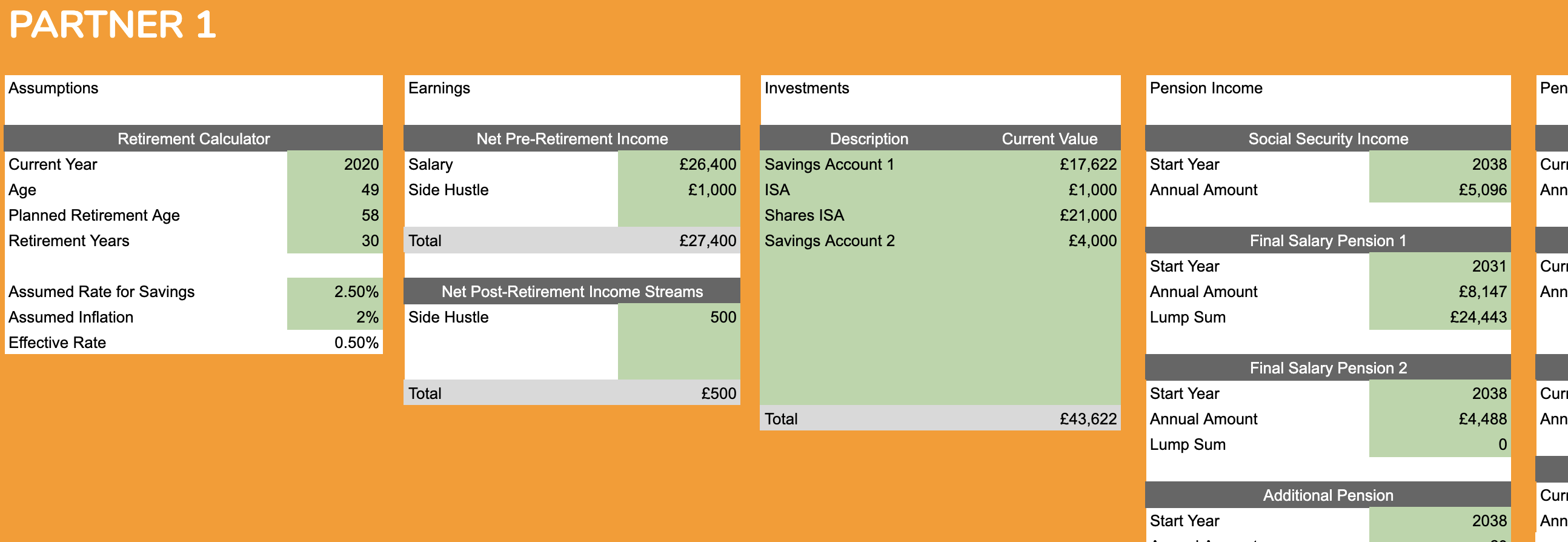
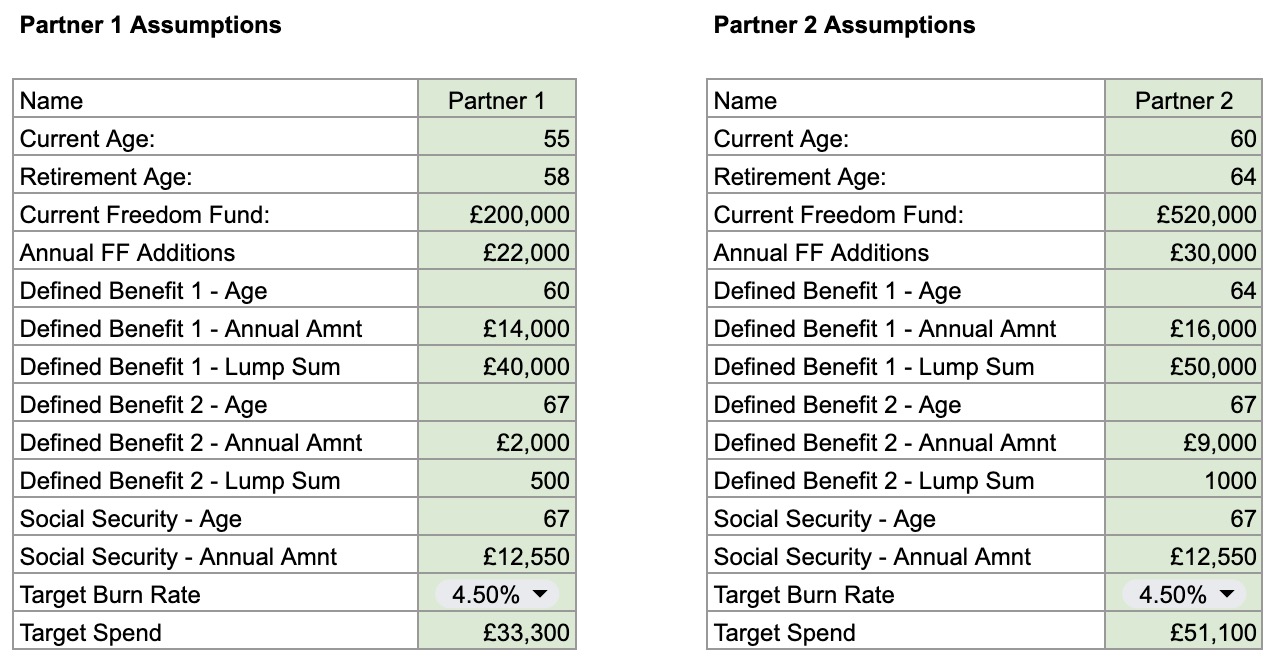
You populate some key figures for both partners, that can include two different defined benefits (including lump sums), state pension and your investment pot.
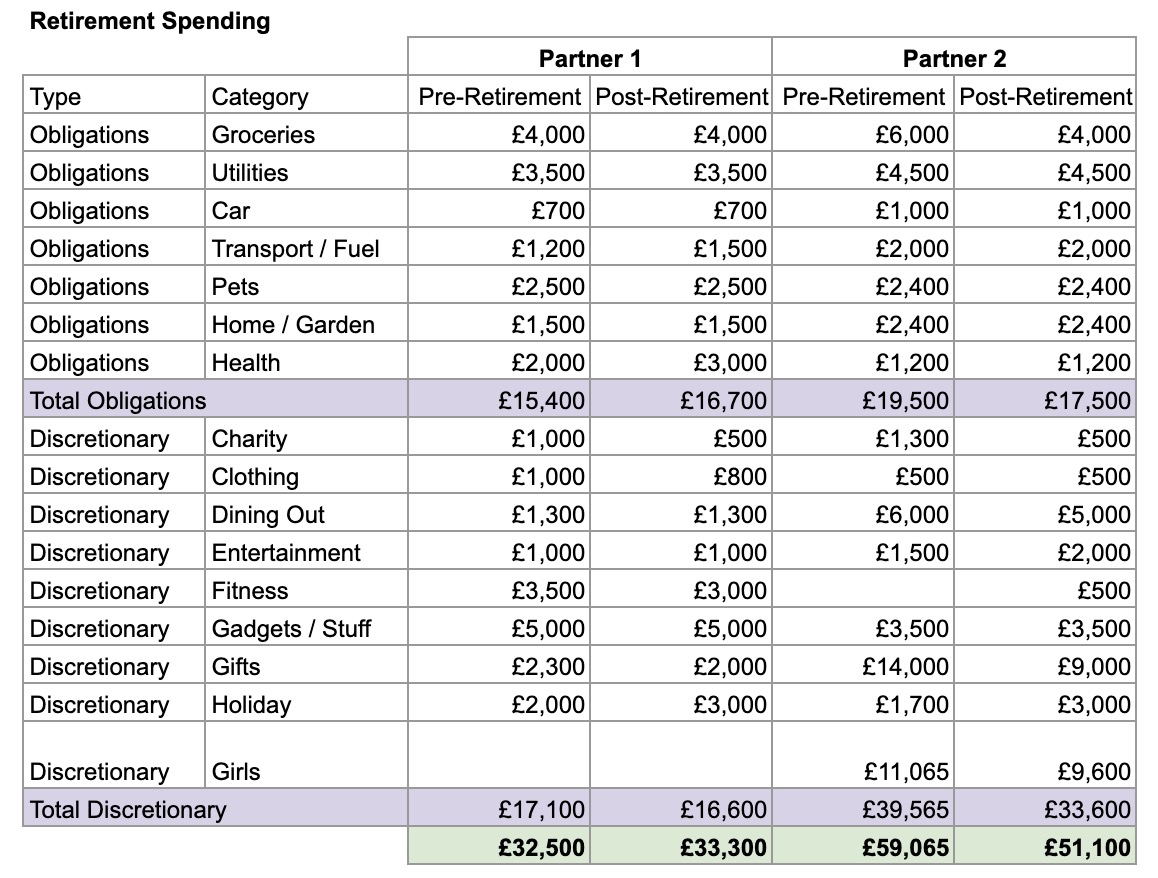
There’s a section for adding your spending assumptions as well. I still use YNAB - You Need a Budget - Budgeting Software and have my expenditure classified in these categories so I can easily see how much I currently spend per year and can adjust for the sort of life I think I might want in retirement.
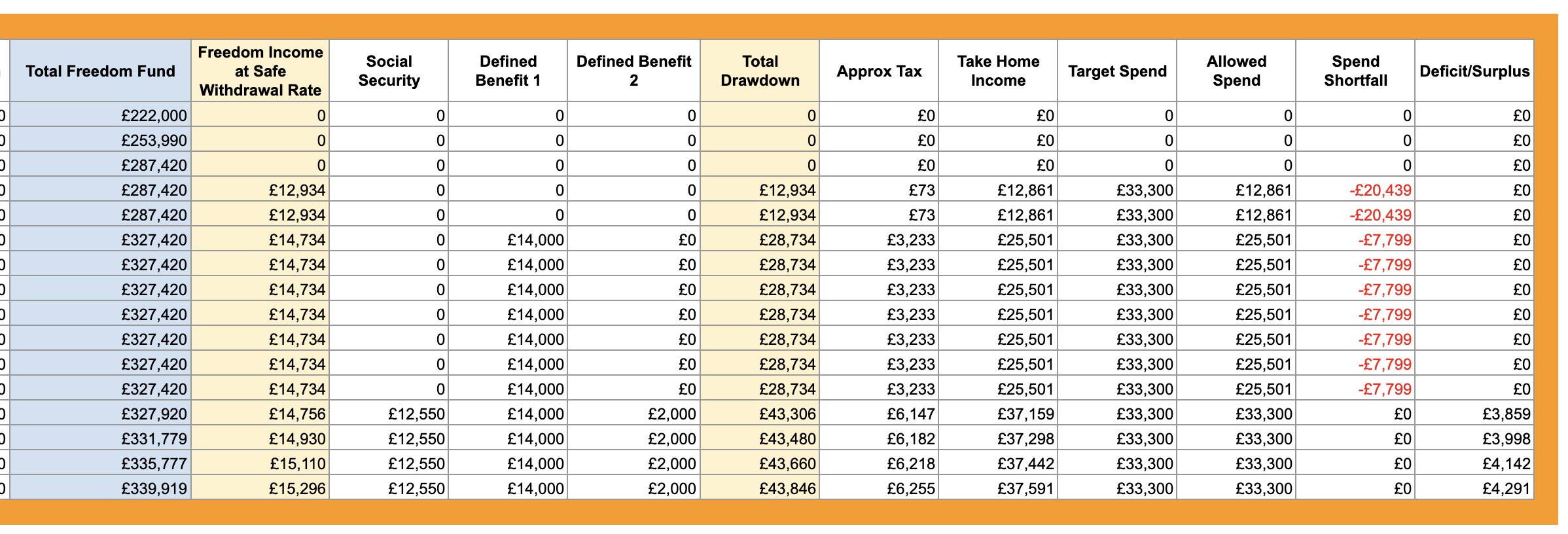
This then tells you year by year, how much you can safely withdraw from your Freedom Fund.
There is something called Sequence of Returns Risk (SORR) - here’s Alan Donegan again:
Sequence of returns risk – this is the risk that you retire at the wrong time just before or after a recession and your portfolio is cut massively. This means that the size of your pot might not sustain your spending at the start of retirement and is more likely to fail or run out.
The way to handle this is to be flexible with your spending, hence why it is useful to understand the discretionary segment of your spending assumptions. If you stick to 4% of your Freedom Fund, even if that is less than your target spend, you will be ok.
I do have an alternative modelling option though, where you can continue with your target spend, regardless. Because we both have a relatively high proportion of our future income as defined benefits, and realistically our ability to spend money will go down as we age, I am prepared to be a little more gung-ho with the planning. Also, I will be retiring a few years before the defined benefits are available and I do not want to spend the first years of my retirement living a restricted life. It’s also important to look at both the individual tables and the combined tables, because while I am living entirely off the freedom fund - it is the joint position that is important. The question becomes, can we both sustain the planned spend.

When this is toggled to Y, you will notice a Deficit or Surplus accumulating in the final column. It is up to you to determine where your comfort level lies. If either of you retire before your defined benefits are available you will be depleting your Freedom Fund. Alternatively, you could retire later, build the pot higher but then you will be losing Freedom Years.

Here are the key assumptions as listed in the spreadsheet:
- Freedom Fund is the current value of all your bonds and stocks and shares investments (preferably global ETF), so that’s S&S ISA, SIPPS, DC Pensions, GI fund etc
- Cash and cash like pots are not included - worth having an emergency fund in cash though
- Burn rate - is the % we are prepared to draw from our freedom fund each year. It is based on the 4% rule and can be either 4, 4.5 or 5% based on your appetite. It is considered safe to assume that with a drawdown rate of 4% and funds invested at least 50% in a global fund / remainder in bonds, your pot will last your lifetime.
- Until you retire the freedom fund will grow at the same rate as your chosen burn rate and whatever deposits you continue to make (eg pension contributions, ISA investments)
- After you retire you must decide if any surplus/deficit adjusts the freedom fund value. The safest thing to do is to reduce your actual spend rather than deplete your freedom fund pot - to do this you must select an “N” in “Model based on target spend rather than the safe withdrawal rate”
- Target spend is exclusive of tax - that will be taken from your drawdown income in the calculator
- Lump sums are assumed re-invested into the freedom fund and not splurged the moment you get them
- Tax is calculated using a worst case scenario. In actual fact you should get a 25% tax free amount from your pension and any income from ISAs should be tax free. So there is much to save here if you’ve juggled your investments and drawdown optimally
- I have hidden rows where we reach steady state - unhide these if you are planning retirement earlier than me and don’t reach steady state in the same timeframe
This article is for informational purposes only, it should not be considered Financial or Legal Advice. Not all information will be accurate. Consult a financial professional before making any major financial decisions.
Comments